
Range Intelligence
What your competitors actually sell, counted by garment rather than by category name. Coord reads the garments instead of the labels, so your range and theirs can be set beside each other and mean something.
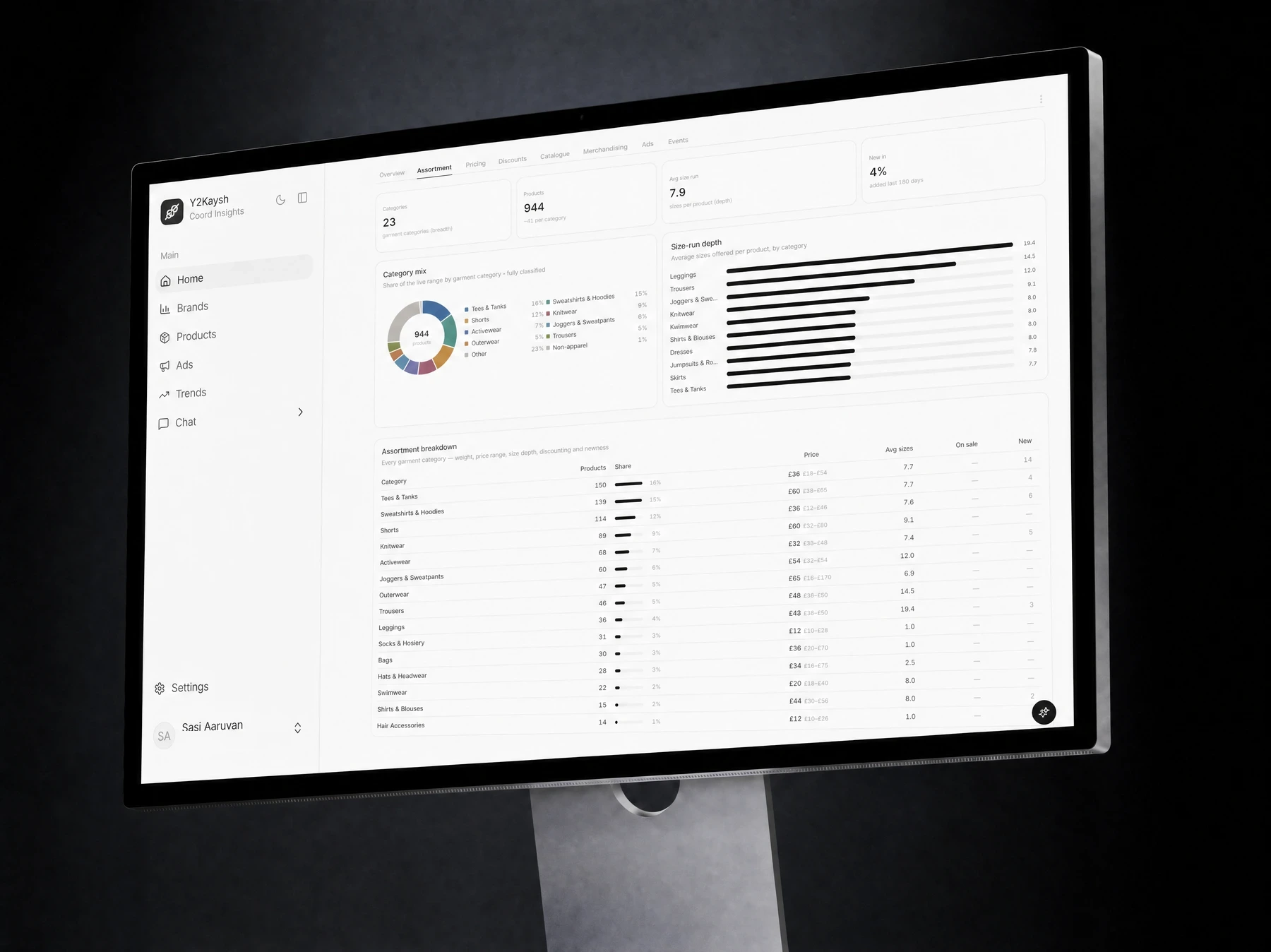
EVERYTHING LISTED, NOT A SAMPLE OF IT.
Their range, counted properly
Not the eighty products on the first three pages of a category. All of it, including the lines that never surface in a search, the sizes carried only in one market, and the colourways that exist but are never merchandised. A range you have only partly seen is a range you will draw the wrong conclusion from.

CLASSIFIED FROM THE IMAGE, NOT THE TITLE
Coord classifies the garment, not the product title.
One retailer files it under knitwear, another under jumpers, a third calls it a fine gauge crew and puts it in tops. Coord looks at the garment in the photograph, at the silhouette, the neckline, the gauge and the shade, and classifies from that. Two ranges become comparable because the same eye read both.
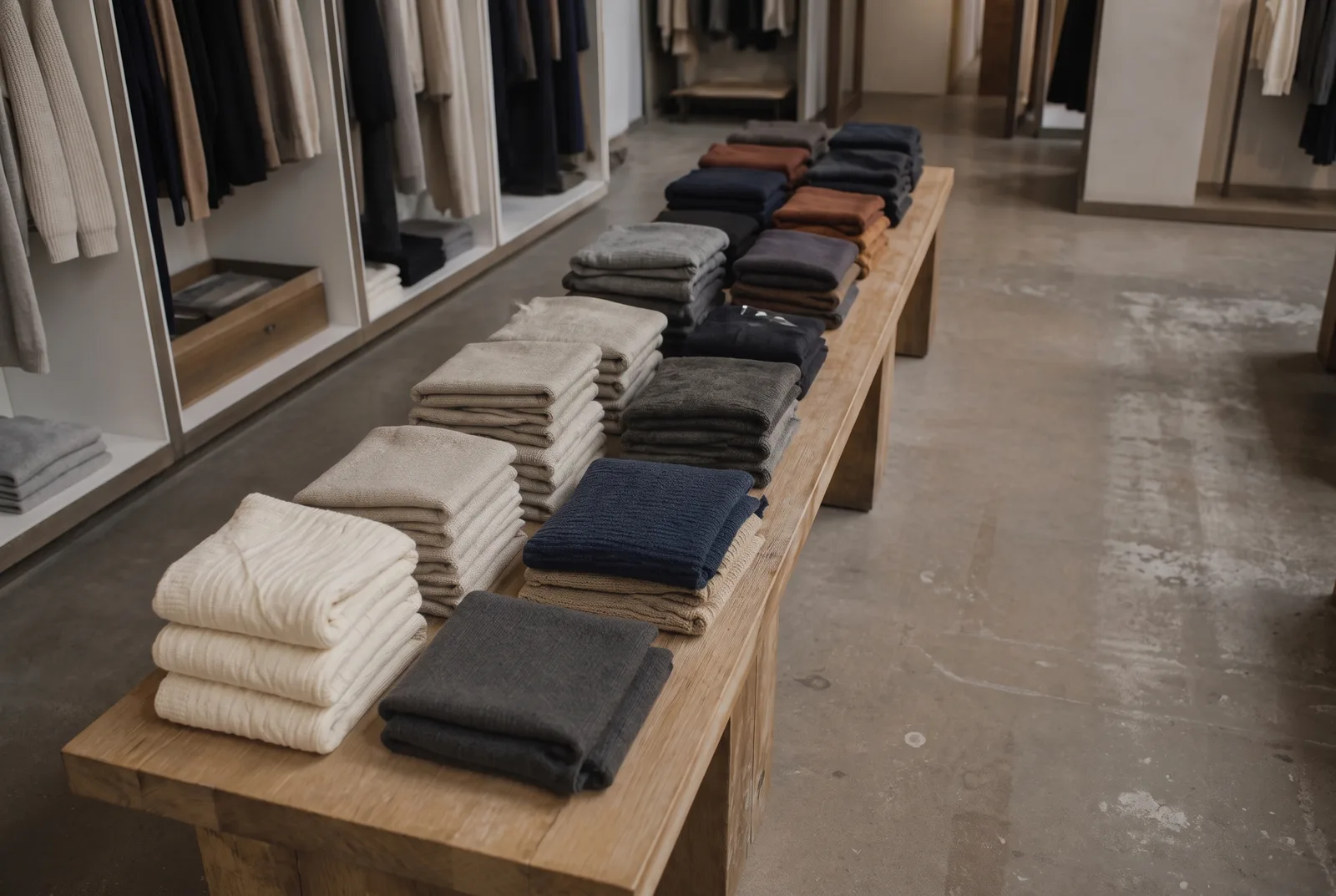
ARRIVALS ARE ANNOUNCED. DELETIONS ARE NOT.
What landed this week, and what quietly went
New lines arrive with a campaign behind them, so they are easy to notice. A line withdrawn makes no announcement at all. It simply stops appearing, which looks exactly like a size being out of stock until you have watched it long enough to tell the difference. Coord tracks both, and the deletions are usually the more useful half.

WIDE AND SHALLOW, OR NARROW AND DEEP
How many options, and how much conviction behind each.
Forty styles in one colourway apiece and eight styles in five colours are opposite bets on the same category. Coord holds the option count, the colourway spread and the size range per line, so you can see whether a competitor is hedging across a category or committing inside it.

WHITESPACE RUNS IN BOTH DIRECTIONS.
The gap in your range, and the one in theirs
Every competitor carries something you do not, and you carry something none of them do. The first is a gap worth considering; the second is either a position worth defending or a line nobody else thinks is worth carrying. Coord shows both sides so the difference is a decision rather than an assumption.
A SEASON OF SMALL CHANGES IS A STRATEGY.
Where the weight of a range is moving
No retailer announces that it is quietly moving out of tailoring and into knitwear. It shows up as a few fewer styles each drop, in one category, for four months. Coord holds the category mix over time, so the drift is visible while it is still a trend rather than after it has become their new range.
Two ranges, read by the same eye.
Every retailer names, files and photographs its range differently, and none of it was built to be compared with anybody else's. Coord reads the garment itself, so the comparison is between what is actually being sold rather than between two sets of words about it.
Completeness
A range is captured in full rather than sampled. What a category page chooses to show first is a merchandising decision, and it is not the range.
Classification
Garments are classified from the image, not from the retailer's own taxonomy. Two ranges filed differently are still comparable.
Your taxonomy
Comparisons are expressed in the categories your team already uses, so a range sits beside yours without being translated first.
Evidence
Every line carries the page it was found on and when it was seen, including the lines that have since disappeared.
Your range
What you carry is yours. Your range is never shared with another customer, pooled into a benchmark, or used to train a model.
See your range beside theirs.
A live walkthrough on your own category: what your competitive set carries, where the gaps are, and what has moved this season.